

Scent-sensitive shoppers’ non toxic perfume selection is the process of checking ingredients, scent families, and application formats to find a personal fragrance that fits their preferences without treating any label as a safety guarantee. This 2026 guide helps you compare citrus, floral, and woody scents while keeping your own sensitivities—not the product’s promises—at the center.
- Choose non toxic perfume by disclosed ingredients and personal tolerance, not clean or natural labels alone.
- Blissfully Rooted offers personal fragrance rollers; compare each formula rather than assuming every roller contains only essential oils.
- Citrus, floral, and woody describe scent character—not allergy risk, hormone effects, or guaranteed gentleness.
- Choose a roller for targeted application, but remember that skin contact still requires attention to ingredients and directions.
Why fragrance choices matter for scent-sensitive shoppers
A fragrance can sound lovely on a page and still be wrong for you. Shopping online adds another difficulty: words such as fresh, soft, and clean describe an impression, not exactly how a formula will smell or feel when you wear it.
The best starting point is an ingredient question, not a scent promise. Before choosing lemon over lavender, separate what you enjoy smelling from what you already know you need to avoid.
Blissfully Rooted makes personal fragrance rollers alongside other home and personal care products. Blissfully Rooted personal fragrance is best for shoppers who want to compare roller options before choosing a scent.
That is a format-based recommendation, not a promise of suitability. Your decision still belongs at the individual product level, where the ingredients, application directions, and scent description can be considered together.
How to choose a personal fragrance that fits you
Start with your own scent history
Begin with what you already know. You do not need a new purchase to notice whether you usually prefer a lemon peel impression, a flower-forward scent, or something warm and woody.
Write down the products you enjoyed and the ones you stopped using. Separate dislike from a physical reaction: finding a perfume too sweet is different from developing irritation, and neither tells you the complete formula.
Keep this record practical rather than diagnostic. If fragrance has caused breathing problems or significant skin symptoms, speak with a qualified clinician before experimenting with another scented product.
- Name a scent you enjoy without assigning it a safety label.
- Record products you stopped using and what happened.
- Note whether the issue involved skin contact, airborne scent, or both.
- List ingredients you have already been advised to avoid.
Read the formula before the fragrance story
For your 2026 shopping shortlist, look for the ingredient information before reading the mood-setting description. A phrase such as a peaceful evening tells you the intended atmosphere; it does not tell you what is inside.
Essential oils are aromatic materials derived from plants. Fragrance oils are formulated scent mixtures, and their composition varies. A roller format does not establish which type a product contains, and a botanical scent name does not establish that the matching essential oil is present.
Blissfully Rooted personal fragrance options should be assessed individually. Do not assume that every roller shares the same carrier, scent ingredients, or essential-oil-only formulation simply because the bottles belong to one collection.
- Find the disclosed ingredients for the exact product.
- Distinguish the carrier ingredients from the aromatic ingredients.
- Check whether the description identifies essential oils, fragrance oils, or both.
- Ask about an ingredient you need to avoid before ordering.
- Set aside a product if its disclosure cannot answer your essential questions.
Choose a scent family without ranking its safety
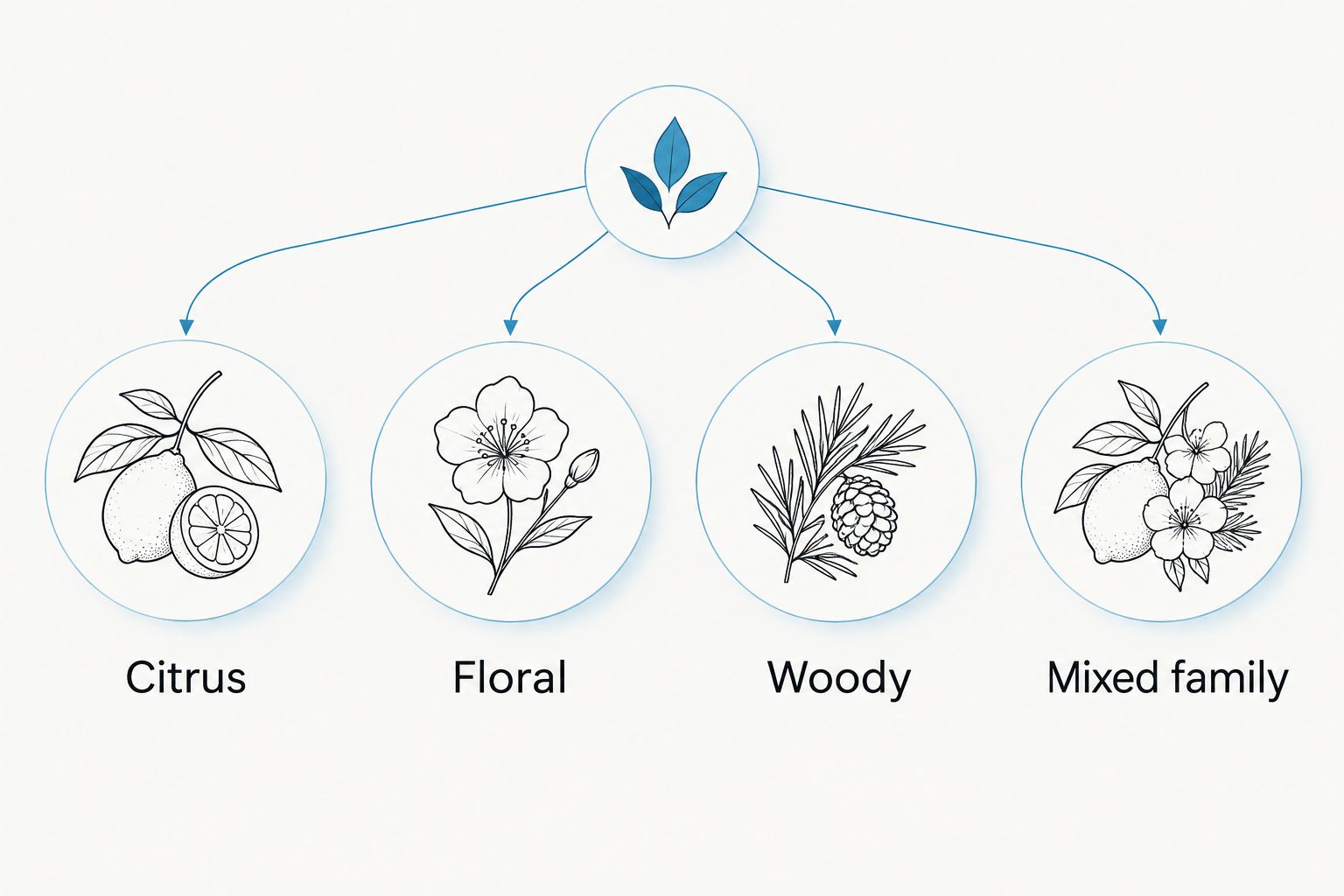
Citrus, floral, and woody are useful starting points because they describe different scent directions. They are not safety categories. A citrus perfume is not automatically gentler than a floral perfume, and a woody perfume is not automatically heavier on your skin.
Citrus descriptions commonly point toward lemon, bergamot, or orange impressions. Floral descriptions point toward flowers such as lavender or jasmine. Woody descriptions suggest materials such as cedarwood or sandalwood, though the scent impression does not prove those materials appear as ingredients.
You can also choose a bridge between families. A lavender-and-lemon description connects floral and citrus impressions; a jasmine, bergamot, and cedarwood description spans all three. Read the whole blend rather than buying on its most familiar word.
- Citrus: best for shoppers seeking a bright, peel-like scent direction.
- Floral: best for shoppers who enjoy flower-forward scent descriptions.
- Woody: best for shoppers seeking wood-like or earthy impressions.
- Mixed family: best for shoppers drawn to a combination rather than one dominant theme.
Match the format to how you want to apply it
Compare 2 formats first: a roller and a spray. A roller applies product at a selected point of contact; a spray disperses product from a nozzle. That mechanical difference matters when you are deciding how you want to use fragrance.
A roller offers targeted application, not automatic gentleness. It still places ingredients on your skin. A spray is not inherently unsuitable either; its fit depends on the formula, directions, your preferences, and your sensitivity history.
Start with the format that answers your practical need. If you want a personal scent rather than fragrance throughout a room, keep your shortlist focused on products intended for personal use. Candles, wax melts, and linen sprays are separate categories, not substitute perfumes.
- Choose a roller when targeted application is your priority.
- Choose a spray only when you are comfortable with its application method.
- Confirm that the product is intended for the place you plan to apply it.
- Follow the product’s directions rather than transferring instructions between formats.
Introduce one fragrance without layering
An unhurried first use gives you a clearer impression than combining several new scents. Try 1 new fragrance at a time, according to its directions, rather than adding a new roller, scented body cream, and room fragrance together.
This is a way to simplify your observations, not a home test that proves safety. A small application cannot guarantee that later use will be reaction-free. Stop using a product if it causes symptoms, and seek medical advice when symptoms warrant it.
Choose an ordinary setting where you can stop using the fragrance rather than making a wedding, journey, or shared workplace your first experience. You do not owe a perfume a full day of wear just because you bought it.
- Keep other new scented products out of the introduction.
- Follow the stated application directions.
- Avoid treating a pleasant first impression as proof of future tolerance.
- Stop use if the product causes irritation or other symptoms.
Keep a short record before choosing another scent
Your most useful 2026 fragrance guide is the one that records your actual preferences. Keep 3 details together: the exact product, what you liked or disliked, and any symptoms or practical problems you noticed.
A brief note also helps distinguish scent family from blend. Disliking one sweet floral does not mean you dislike every floral fragrance. Similarly, enjoying one lemon blend does not establish that every citrus ingredient agrees with you.
Review the record before adding another product. You might discover that you want a less sweet description, a different application format, or simply fewer scented products in your routine.
- Save the exact product name and ingredient information.
- Describe the scent in your own plain language.
- Note the application method and other scented products used alongside it.
- Record discomfort separately from scent preference.
- Use the record to narrow—not expand—your next shortlist.
Compare roller options before choosing a scent
For this 2026 comparison, the useful distinctions are the disclosed scent descriptions and product formats. These options are not ranked by safety, strength, or lasting power because those conclusions require information beyond their names.
The product names below identify shopping candidates. Treat their scent wording as a starting point, then check the individual formulation before deciding. Cashmere and amber, for example, are fragrance descriptions rather than a complete ingredient list.
| Option | Best for | Useful distinction | Key limitation |
|---|---|---|---|
| Lavender Lemon Roller | Shoppers exploring a floral-citrus direction | The name identifies lavender and lemon scent cues in a roller format | The scent name alone does not establish the complete ingredients or personal tolerance |
| Luxe Cashmere Roller | Shoppers interested in a cashmere-and-amber description | Offers another scent direction without switching away from a roller | Cashmere and amber wording does not identify every aromatic ingredient |
| Last One Standing Fragrance Roller | Shoppers comparing another personal fragrance roller | Keeps the application format consistent while you investigate another option | Confirm this roller’s own scent notes and ingredients; do not borrow another format’s formulation |
The first two rollers are listed as 10mL products. That shared size helps you compare the format, but it does not establish equal concentration, equal wear time, or equal suitability.
If either scent direction fits your shortlist, use the product details as your next reading step. The names on the cards include the brand’s wording; terms such as hormone safe are not a guarantee of hormone-related outcomes or reaction-free use.


Common mistakes scent-sensitive shoppers make
Treating non-toxic as a complete ingredient explanation
Non-toxic and clean do not tell you which carrier or aromatic materials a perfume contains. Ask what the wording refers to, then decide whether the disclosed facts answer your concern. A reassuring label cannot replace information about an ingredient you need to avoid.
Assuming natural means reaction-free
Plant-derived materials can still cause unwanted reactions. Essential oils are not automatically suitable for every scent-sensitive shopper, and fragrance oils cannot be judged as a single identical formula. Assess the actual product rather than choosing a side in a natural-versus-synthetic argument.
Choosing only by the first scent note
A lemon-led description can include floral or woody elements too. Read the full scent description, especially when a note you dislike appears later in the blend. The familiar word on the front is not the whole perfume.
Copying a scent across every product format
Enjoying a personal fragrance does not mean you need its candle, room spray, and diffuser counterparts. Each format has a different use, and surrounding yourself with the same scent does not make it easier to assess a new roller. Start with the personal product you actually want.
FAQ
What does non toxic perfume actually mean?
Non toxic perfume is a shopping description, not a guarantee that a fragrance will be reaction-free. Evaluate the individual product’s disclosed ingredients, intended use, and directions rather than relying on the phrase alone.
What’s the best perfume for someone who is scent-sensitive?
There is no single perfume that is best for every scent-sensitive person. Start with your known sensitivities and ingredient questions, and seek clinical guidance if fragrance has caused significant symptoms.
Is citrus perfume gentler than floral or woody perfume?
Citrus perfume is not automatically gentler than floral or woody perfume. These categories describe scent character; the actual formulation and your individual response matter more than the family name.
Are fragrance rollers always made with essential oils?
Fragrance rollers are not always essential-oil-only products. Roller describes the applicator, so check each formula for its carrier and aromatic ingredients rather than inferring them from the bottle.
Is a perfume roller better than a spray for sensitive shoppers?
A perfume roller is better for shoppers who specifically want targeted application, but it is not automatically safer than a spray. Both formats require attention to ingredients, directions, and personal sensitivity.
Does hormone-safe wording mean a perfume cannot affect hormones?
Hormone-safe wording alone does not establish that a perfume cannot affect hormones. Do not treat the label as a medical promise or as proof of suitability during pregnancy or for another health concern.
Can I use a room spray as perfume if I like the scent?
Use a room spray on your body only when the product explicitly identifies that use and provides directions for it. A shared scent name does not mean a room fragrance and a personal fragrance have interchangeable formulations.
One last thing
You do not have to find a signature scent in 2026. A useful result is simply knowing which ingredient question to ask next—or deciding that an unscented routine suits you better.
Blissfully Rooted offers several personal fragrance directions, but collecting them is not the goal. Choose the product you can make an informed decision about, not the one with the most reassuring label.
